The Good Old Days
The Good Old Days
JUN 28, 2026
When I was a child, we would sometimes talk about ‘the olden days.’ That was a period of time, when in our imaginations, our parents or grandparents were children. We’d marvel about them, and try to imagine a world where cars were non-existent, or had exotic extras such as little hands popping out the side rather than actual indicator lights.
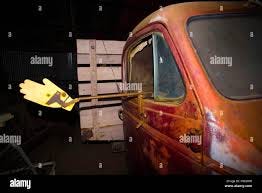
Or realising that people used to stop and stare when an aeroplane went over above you, because they were so exotic. Occasionally we’d hear about ‘the good old days’ when life was ‘simpler.’ And I expect it was in some ways – my parents probably didn’t have to deal with traffic jams, or contemplate the idea of nuclear war when they were children – but I also remember my Mum telling me she had only two dresses. One for every day, and one for ‘good.’
Thanks for reading Leonie’s Substack! Subscribe for free to receive new posts and support my work.
I’ve been thinking about what some people are now referencing as ‘the good old days’ now. Which were apparently when I was a child.
That means the 70s and 80s in Australia. (I was born in the 60s, but don’t really recall much of them.) There are some significant positives.
Australia was, in many ways, the ‘lucky country.’ We had good leave entitlements. Medicare happened, and the true public health system was born. University education was completely free, apart from text books or some personal equipment.
There were also some negatives. Racism was still a significant factor. I was a bit oblivious to it, to be honest, probably because I had great parents, who only judged a person by knowing them. Having said that, I can remember even great parents making a casually racist statement, ‘That’s not a very Australian name.’
We lived through the cold war. We watched the Berlin Wall fall. We saw the dissolution of the USSR. But we also lived through the Gulf War. We did seriously discuss what might happen if nuclear war occurred. In primary school.
When I reached voting age, I was excited to vote, and followed my family norms to a certain extent. I worked on elections, and was paid to be a poll clerk, and then to count senate votes.
And while I remember voting in my youth with fondness, I don’t remember feeling particularly passionate about politics, or even hearing about ‘left and right.’ One government was much like another in many ways, with perhaps a trend towards workers, or slightly away from them. Maybe one was more fiscally sound, but not enormously so. Perhaps it was my naivety. Or perhaps not.
Nowadays, particularly on social media, I hear about ‘right’ and ‘left,’ and how the division is enormous. I have watched as Australian politics has slowly become more categorised on the spectrum of political thought, and how some people have identified more heavily with ‘one side’ or ‘the other one.’
It’s truly disturbing. Because typically, I, like many Australians, was brought up to believe that your vote was your own. You did with it as you wished, and you didn’t have to tell anyone about it. And certainly no-one dictated who you voted for.
Recently (May 2026) a sitting Australian senator, Ralph Babet, the only member of the United Australia Party (financed by Clive Palmer and currently deregistered) ever elected tweeted:
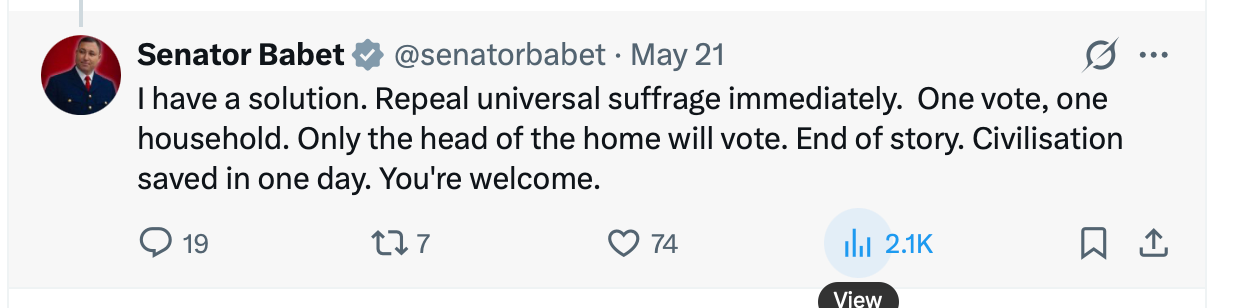
It was in response to an inflammatory article about Greta Thunberg from The Telegraph. You can find the tweet here, if you doubt me.
And most recently, we’ve had Pauline Hanson stand up at the National Press Club and state Australia needs to be a ‘monoculture.’ Monocultures are typically associated with ethnocentricism – the idea that a particular type of ethnic expression is superior to other expressions.
This is the woman who thinks she might be a valid option as Prime Minister.
Unless you’re an indigenous Australian, you have a background of immigration to Australia. We were all once migrants of some sort. For example, my grandad came from the UK. My husband came from New Zealand. (Mind you, I suspect Ms Hanson might approve of my background, because it’s predominantly white. She tends to ignore the idea of white immigrants to a large extent.)
And then there’s the ongoing ‘left/right’ thing that is now evident in Australian media, social media, and some discourse on politics.
To my dismay, people I’ve always thought pretty sensible, are now posting memes suggesting that one issue defines where you should sit politically. This is the politics of anger.
It’s also the politics of lack of thought. No-one is ever going to agree 100 percent with any political party or person. In the end, it’s about who you most agree with, or which issues are most important. And to decide that, you need to be able to examine policies, and platforms that spell out what exactly each group is going to do about those things.
If you have look at One Nation’s policies, you’ll see they’re very short on any kind of detail. I went and had another look today. Lots of statements – not much substance. I’ll let you find your own way there, rather than linking.
But back to my main point. While people can absolutely subscribe lock, stock, and barrel to one type of view point, the reality actually is that most of us will agree with some stuff, and not other stuff. I rather like the ABC’s vote compass, which you can find here. It plots where you sit on a range of things, against the major parties’ policies. The one I’ve linked was to the 2025 election, but you can still use it. Just be aware that it will ask you about party leaders from that election. I did it again, and this is me:
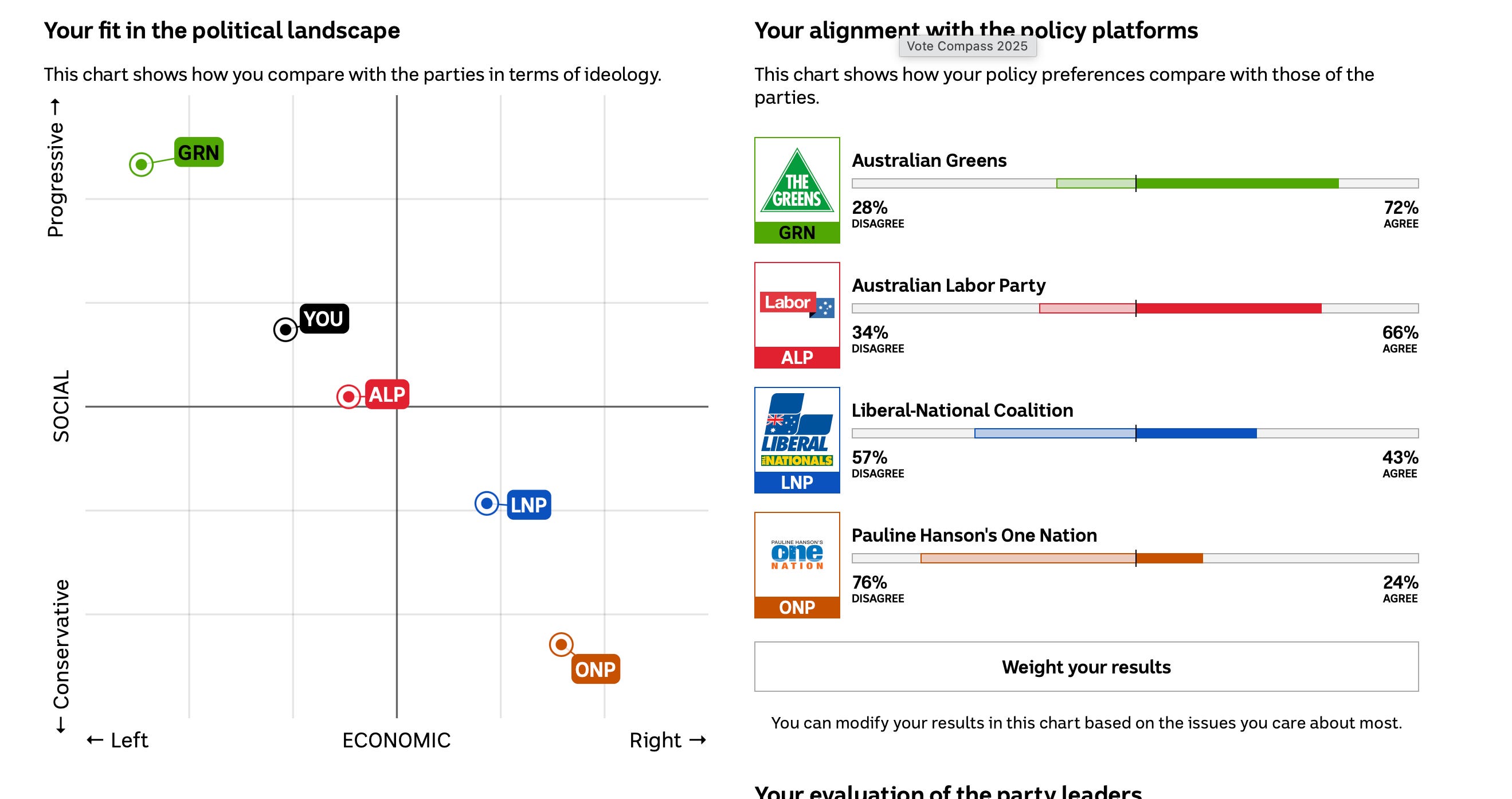
And despite the fact that this vote compass has me as a socially progressive lefty, (which I do find rather amusing), I would not label myself as such. I’m a swinging voter, who is happy to weigh stuff up. And obviously, some things (to everyone) are more important than others.
But I’d encourage you to try it out – you can even look at what the major parties’ pre-election policies were, question by question.
What I’m trying to say most of all, is that we exist on a spectrum. We are not the same. Our values will be different from person to person. Maybe in some circumstances we will sit further in one direction than another, but generally we will find middle ground.
I would encourage anyone who has devolved into the ‘one issue completely trumps another’ setting, to examine other issues, and see how they all interplay, and how they’re all interlocked. One thing sets of another, then another, then another. Try and see – looking wide – how getting rid of one thing might lead to disaster in another area.
In addition, I’d suggest you look deeply at how parties vet their candidates. I’ve never quite gotten over the surprise of seeing an acquaintance on a senate ballot paper as a party’s candidate. That party had clearly not vetted their candidate. If you live in a small town, you’ll understand what I’m saying here.
You can possibly guess that anyone who thinks only ‘the head of the household should vote’ and that ‘we should do away with universal suffrage’ will not ever get my vote. Nor will a party funded by anyone who funded a person with such views.
But that’s probably ‘my’ type of extremism at work, if you like. I’m at heart, a feminist.

